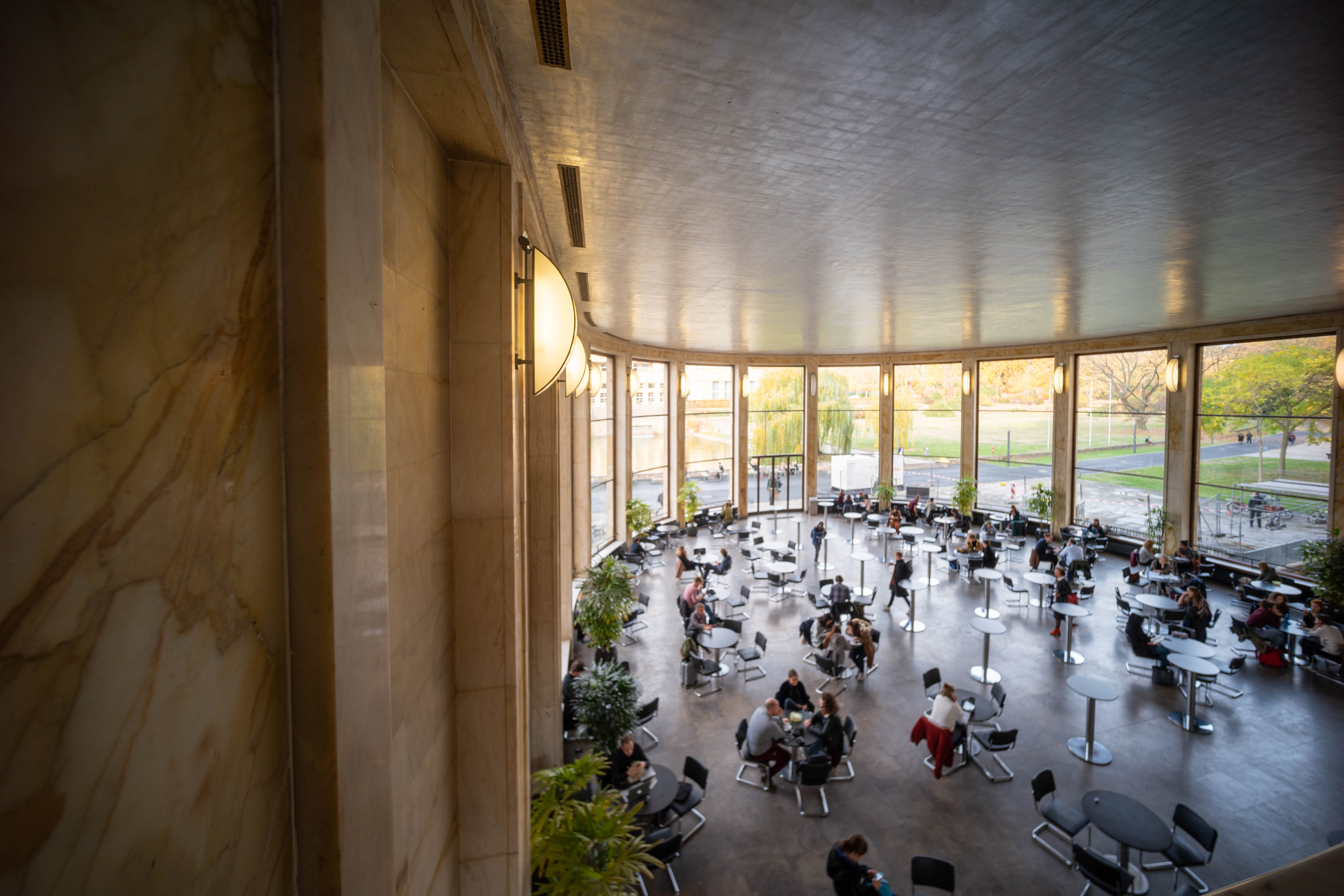
The IG Farben Building, now known as the Poelzig Building or IG Farben-Haus, is an iconic structure located on the Westend Campus of Goethe University in Frankfurt. Originally designed by the German architect Hans Poelzig, it was built between 1928 and 1931 as the headquarters for IG Farben, once one of the largest chemical companies in the world. The building is a significant piece of architectural and historical heritage and is one of the landmarks of modernist architecture in Germany.
Here are some key aspects of the IG Farben Building:
Architectural Significance
- The IG Farben Building is renowned for its modernist design, characterized by its clean lines, curved façades, and symmetry. Hans Poelzig’s design features a central crescent shape, which is rare in large-scale office buildings of that era.
- The building is vast, covering over 250,000 square meters, with a central rotunda and extensive glasswork that allow for natural lighting, making it both imposing and functional.
Historical Context
- During World War II, the building became part of Germany’s wartime industry due to IG Farben’s involvement in chemical production. After the war, it served as the headquarters of the Allied High Commission and later as the site of the American occupation forces.
- The building holds a complex legacy due to IG Farben’s controversial history during the Nazi regime, making it a point of interest for historical study and reflection.
Conversion to Goethe University
- In 1996, the IG Farben Building was transferred to the German government and later to Goethe University, where it was extensively renovated to house various university departments and administrative offices.
- Today, it’s the central building of Goethe University’s Westend Campus, housing faculties like the Faculty of Economics and Business Administration, as well as lecture halls, libraries, and administrative offices.
- The transformation of the building from a corporate headquarters with a dark history to a vibrant academic hub represents an effort to reconcile with and repurpose historical spaces.
4. Campus and Student Life
- The Westend Campus, with the IG Farben Building as its focal point, is considered one of Germany’s most beautiful university campuses. Its spacious lawns, modern facilities, and architectural beauty make it a favorite among students and visitors alike.
- The building’s architecture and history add to the unique ambiance of Goethe University, creating a space where academic pursuits are infused with the weight of historical reflection and modern innovation.
The IG Farben Building at Goethe University stands as a reminder of the complex layers of history and serves as a bridge between Frankfurt’s past and its future, embodying both architectural achievement and a commitment to critical scholarship.