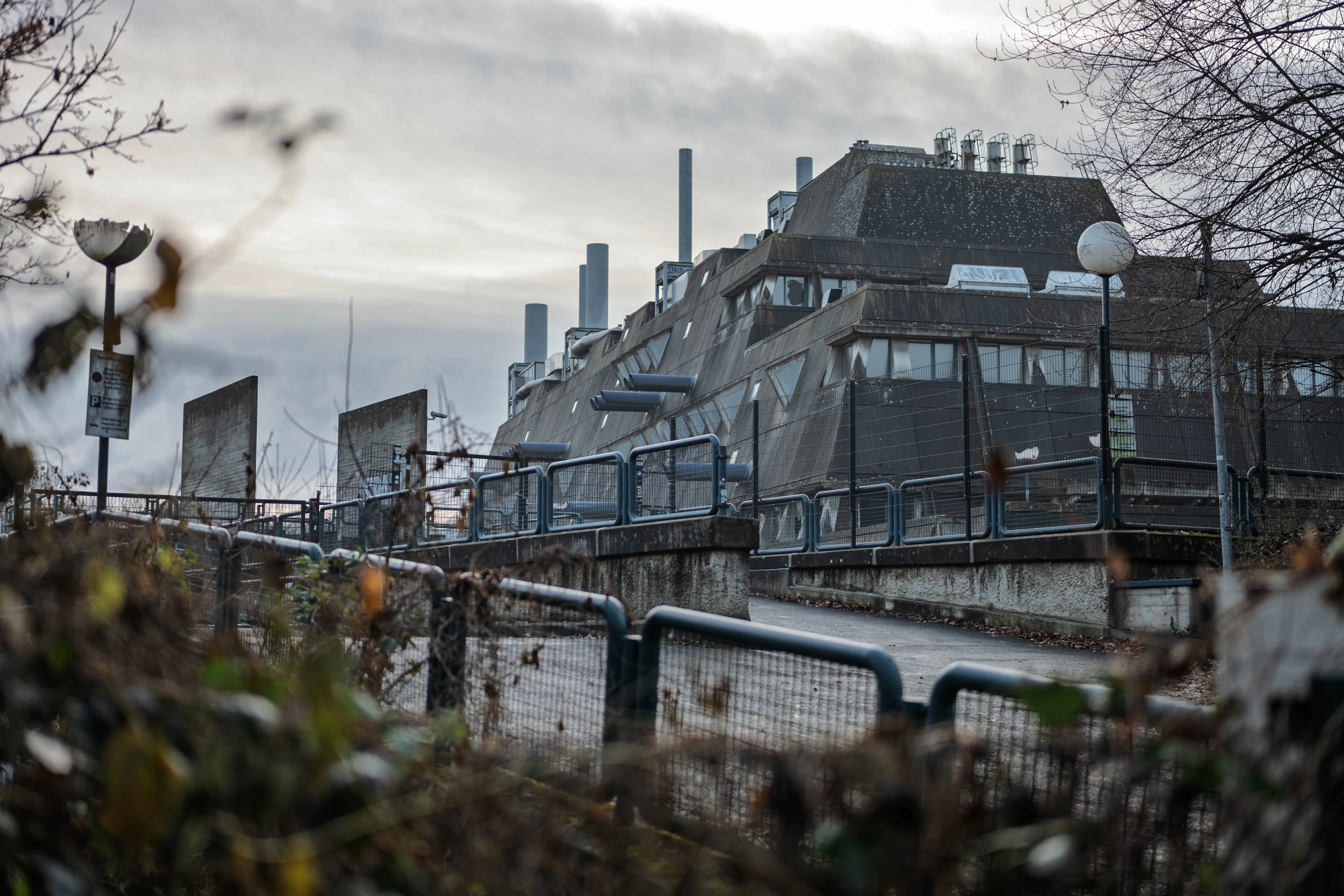
The Mäusebunker, officially known as the Research Facility for Experimental Medicine, is a landmark brutalist building in Berlin. Designed by Gerd and Magdalena Hänska and built between 1971 and 1981, it originally served as a high-security animal research laboratory for the Free University of Berlin and later for the Charité. Its popular nickname, “Mouse Bunker,” refers both to its function as a center for animal testing and to its fortress-like appearance.
Architecturally, the Mäusebunker is regarded as a major example of postwar Brutalism. Its massive, angular concrete body, narrow slit windows, and prominent blue ventilation pipes give it a distinctive industrial character. The building’s bold and uncompromising design has made it an icon among architects, historians, and enthusiasts of modernist architecture.
For decades, the facility housed laboratories and animal testing units, but scientific operations were completely discontinued in 2020. Since then, the structure has remained unused. Due to its specialized layout and the technical requirements of its former function, re-purposing the interior poses significant challenges.
The Mäusebunker was once threatened with demolition, as the Charité considered it obsolete and costly to maintain. After widespread public debate and strong advocacy from preservationists and architectural institutions, the building was officially granted landmark protection in 2023. This status prevents demolition and secures its long-term conservation.
Future uses for the building are still being explored. Cultural institutions, architects, and city planners have proposed transforming it into a venue for exhibitions, artistic production, or community events. Some temporary cultural programs have already taken place inside and around the structure. Although its exact future remains undecided, the Mäusebunker is now protected as a significant piece of Berlin’s architectural history.